Disruptive Women in Health Care · App concept

Built for the advocate who never stops moving.

A speculative mobile companion for health advocacy — from onboarding to impact. Members declare their focus areas, then the app calibrates every feed, surfaces the right connections, and tracks collective outcomes. Built to show what AI-grounded personalization looks like when the members themselves are the intelligence layer.
00 · Onboarding

Personalization from the start.

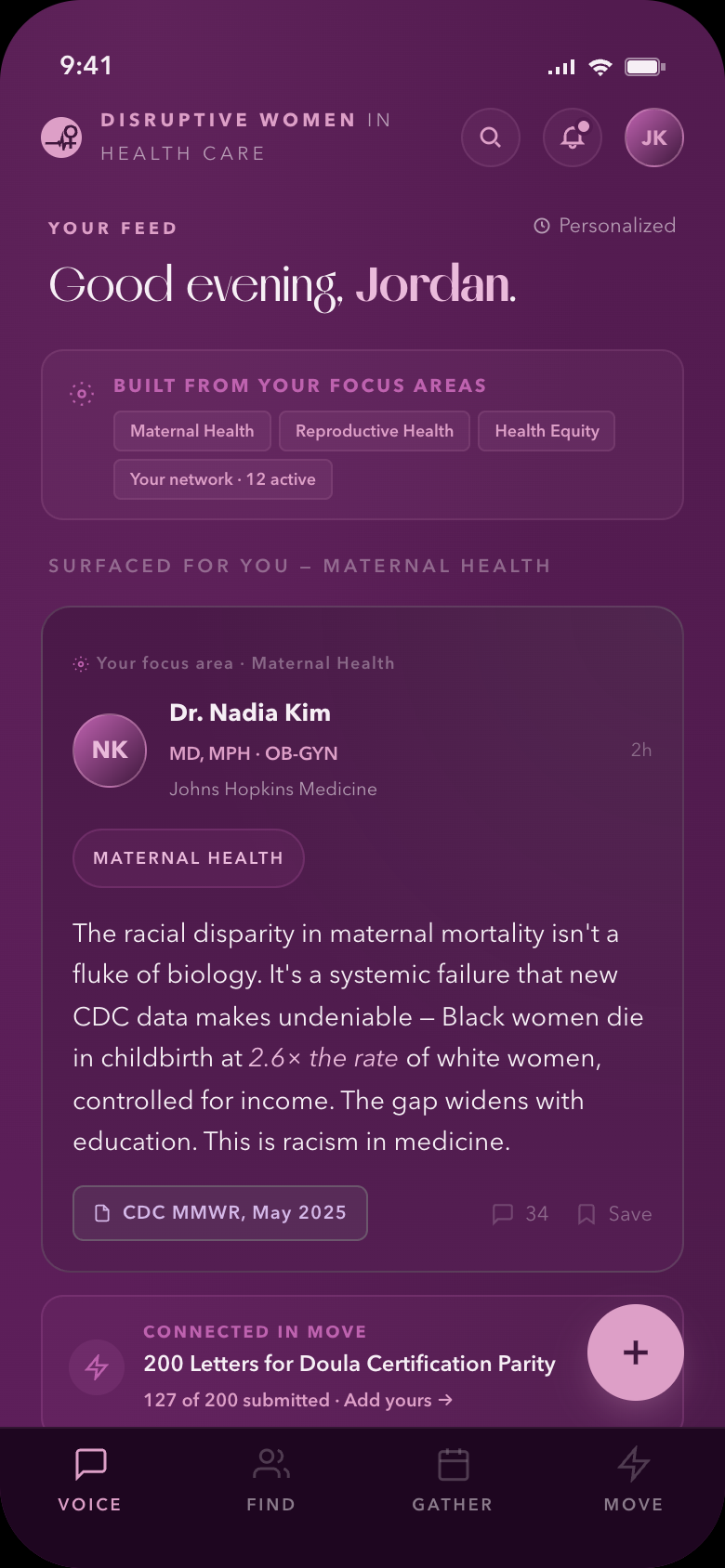
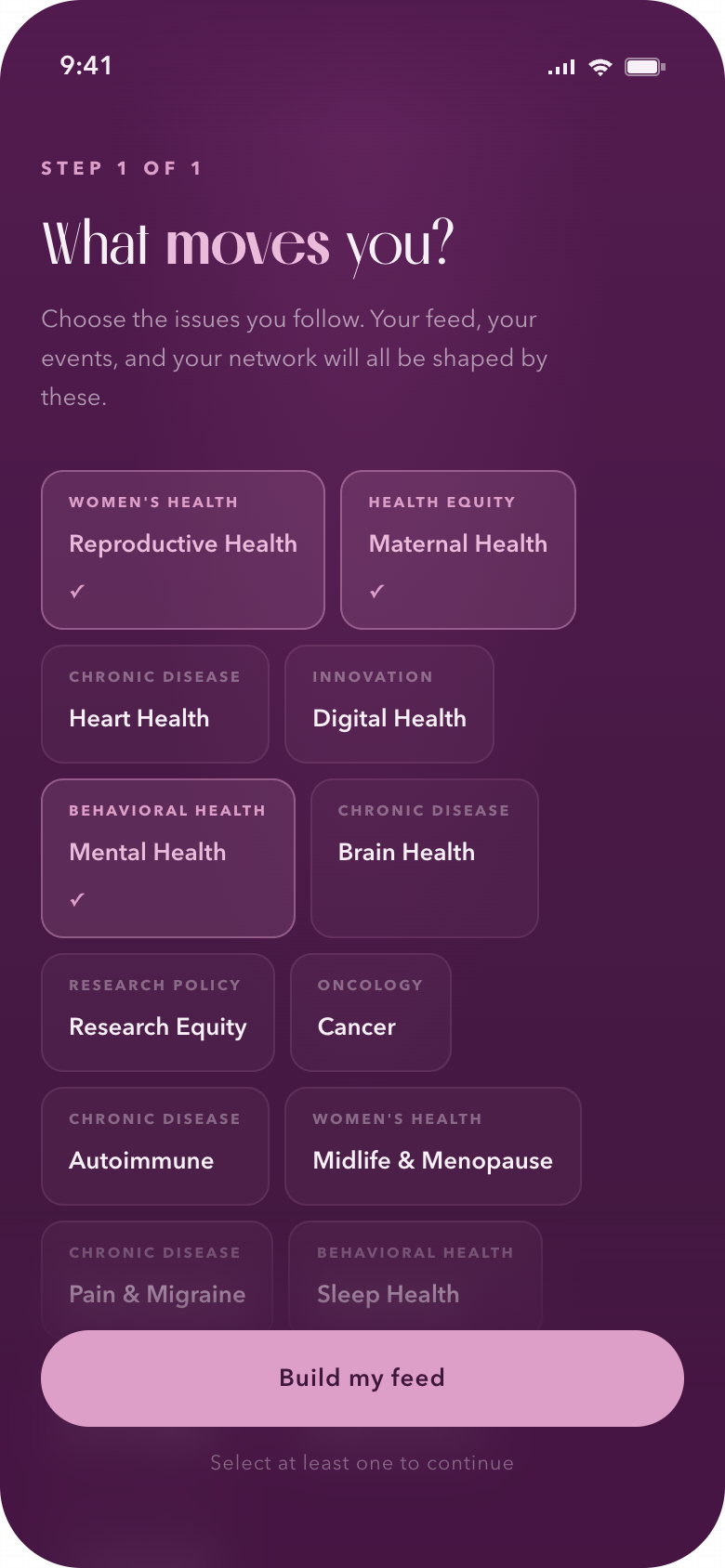
Before a member sees any content, she declares her focus areas — the health domains where her expertise and advocacy intersect. This isn't demographic targeting; it's professional signal. The app uses these selections to calibrate every feed, filter every notification, and surface the network connections that matter.

  • Focus area selection — Maternal Health, Mental Health, Reproductive Health, Chronic Disease, and more
  • Professional context — Not demographics, but declared expertise and advocacy priorities
  • System-wide calibration — Every subsequent feed and notification respects these choices
01 · Voice — Feed

A voice with signal.

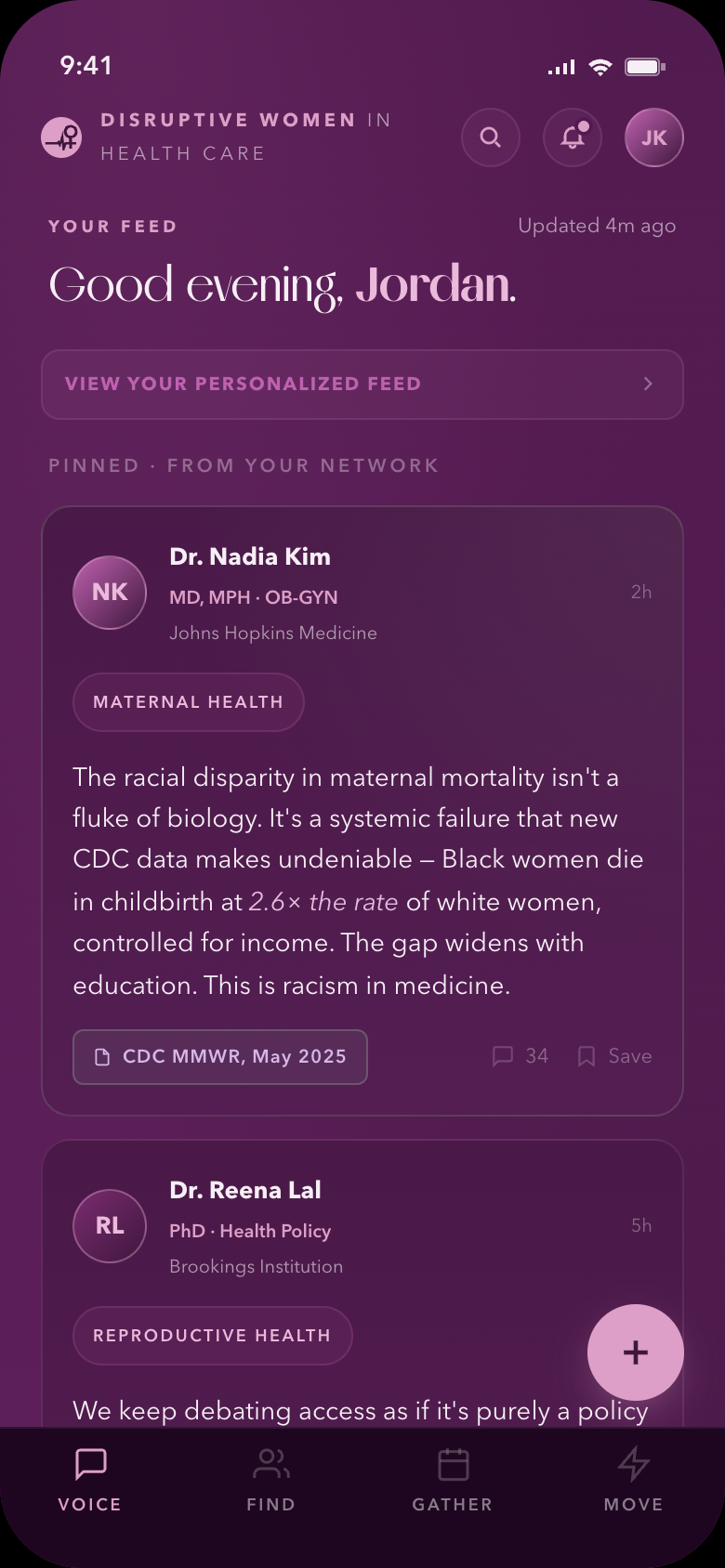
The Voice tab begins as a curated general stream, then sharpens to each member’s declared focus areas. Sourcing indicators render before the copy — the credibility of a post is legible at a glance, before you’ve read a word.

  • General → focus-aware — the same feed, recalibrated to what she’s declared
  • Credential-first — author name, specialty, and affiliation as prominent as the headline
  • Sourced at a glance — evidence attachment renders before the share button
01 · Voice — Compose

From observation to post.

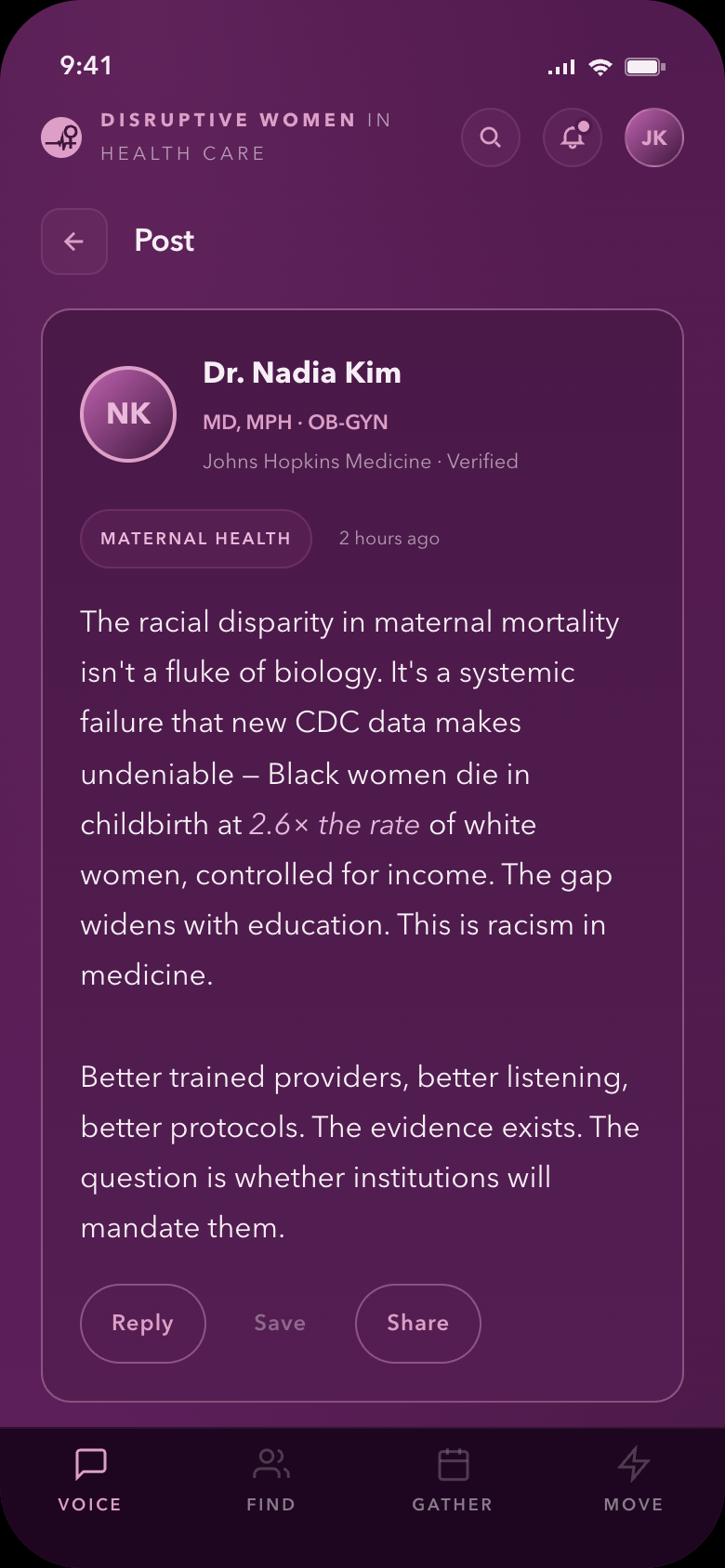
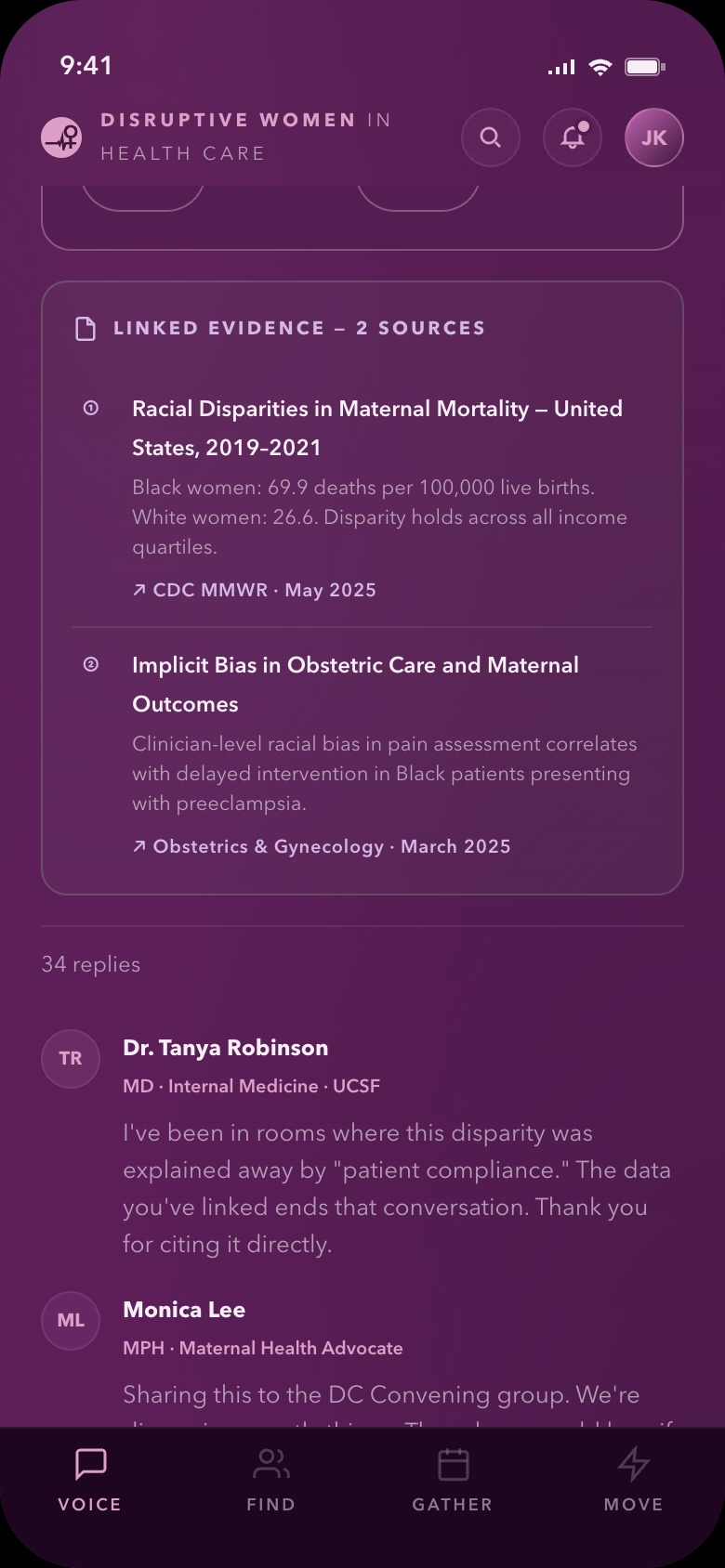
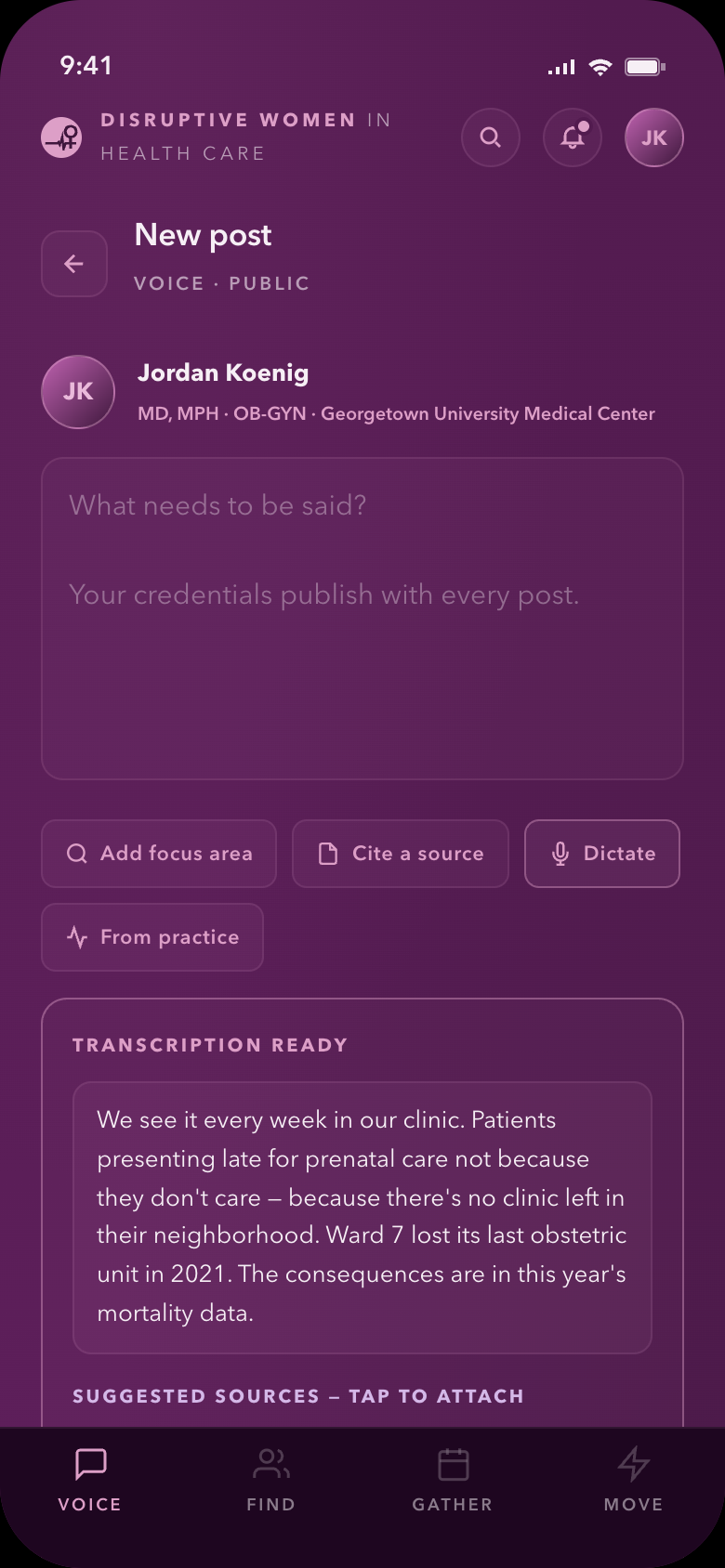
Open any post and a contextual layer surfaces who in her network holds adjacent views, which DW research backs the claim, and which active campaign it feeds. Compose gives her one screen to translate clinical observation into a published position.

  • Contextual layer — network adjacency, sourced evidence, and connected campaign in one view
  • Dictation mode — spoken clinical observation transcribed and matched to suggested citations
  • From practice — a tag signaling the source is embodied expertise, not a paper
02 · Gather — Events

Where momentum collects.

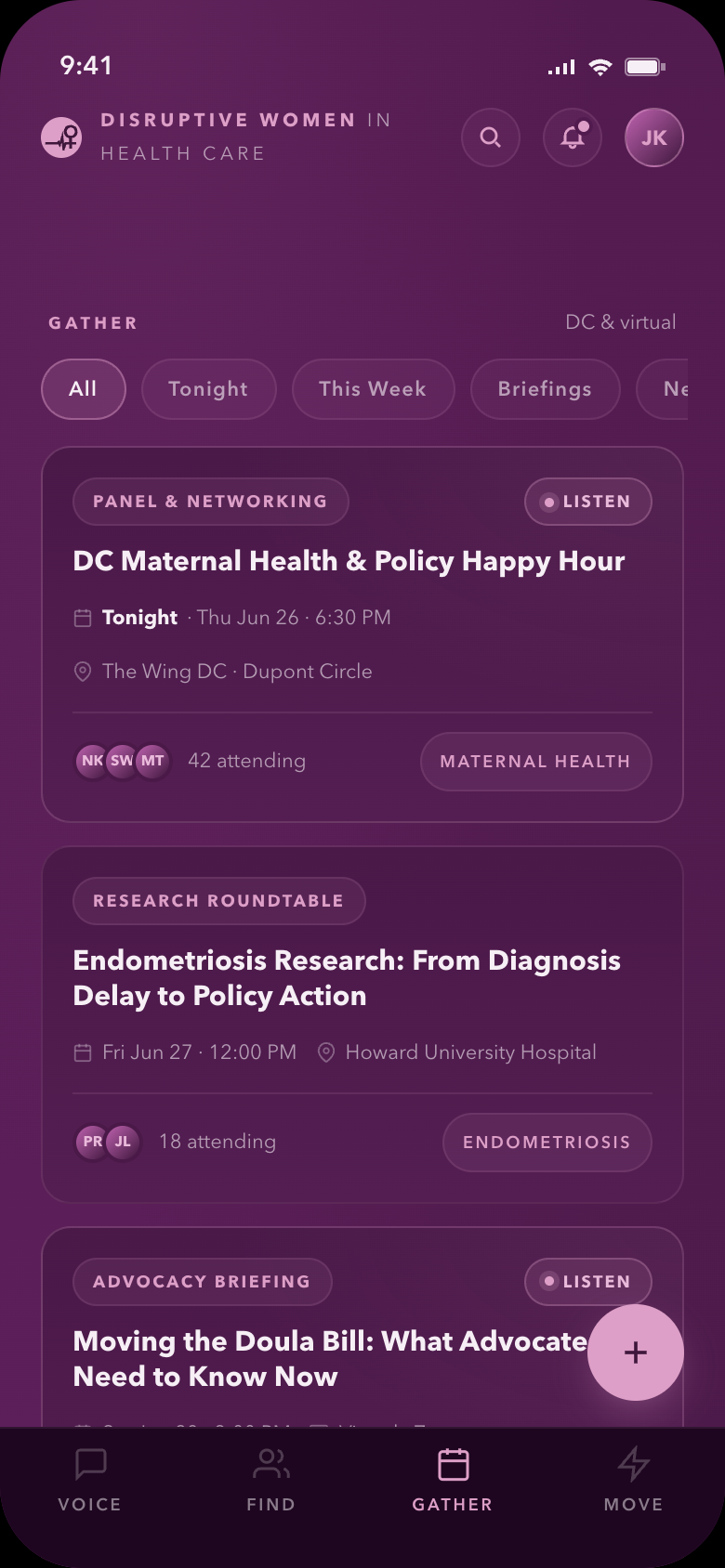
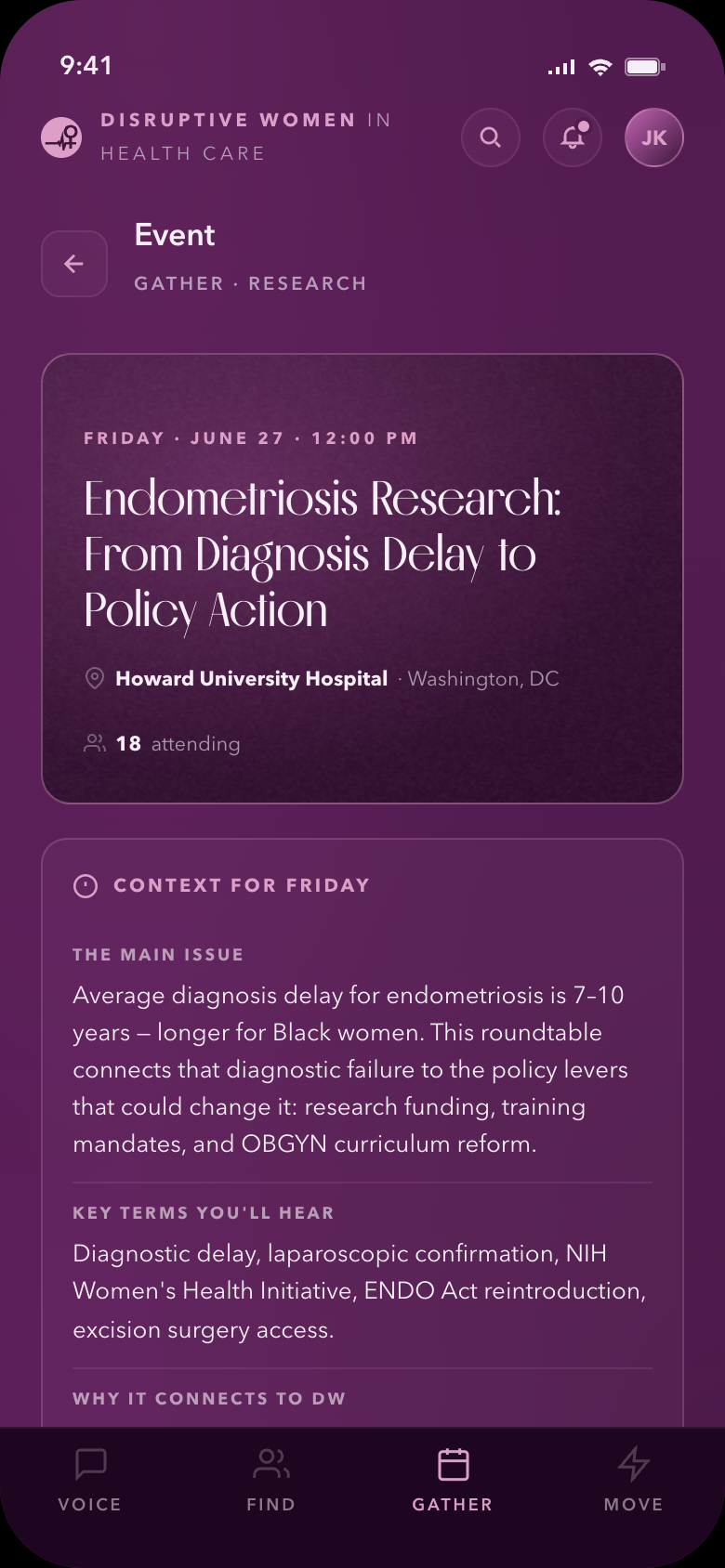
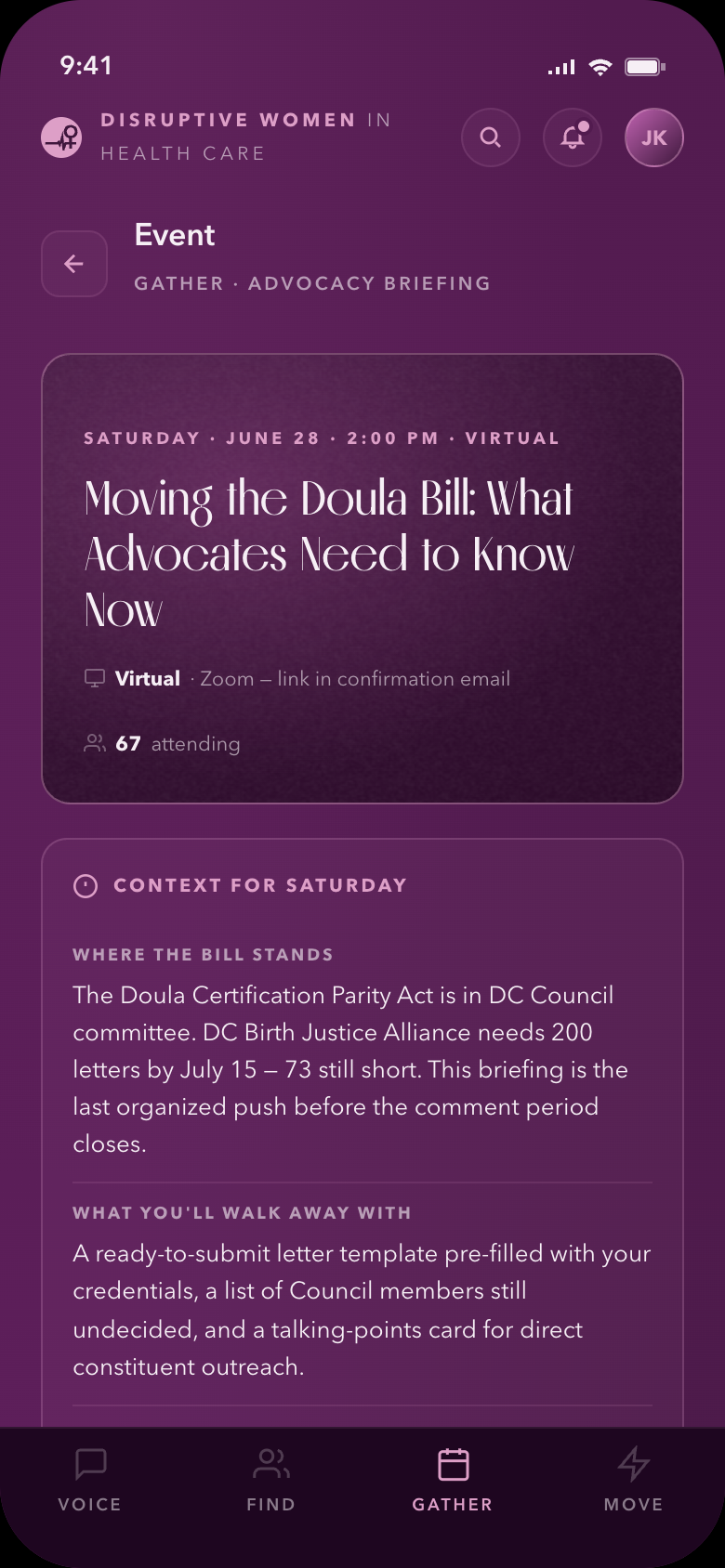
The Gather feed surfaces Capitol Hill briefings, town halls, panels, and listening sessions — filterable by topic, date, or proximity. Three distinct event types show how the same card structure adapts across a professional convening, a congressional hearing, and a virtual advocacy briefing.

  • Event discovery — filtered by topic, proximity, date, event type
  • Multiple formats — panels, hearings, and virtual briefings share one consistent card
  • Context, not just a calendar entry — the virtual briefing shows where a bill stands and what letters still short of a target
  • RSVP in one tap — no context switch to a calendar or external registration
02 · Gather — Depth

Before, during, after.

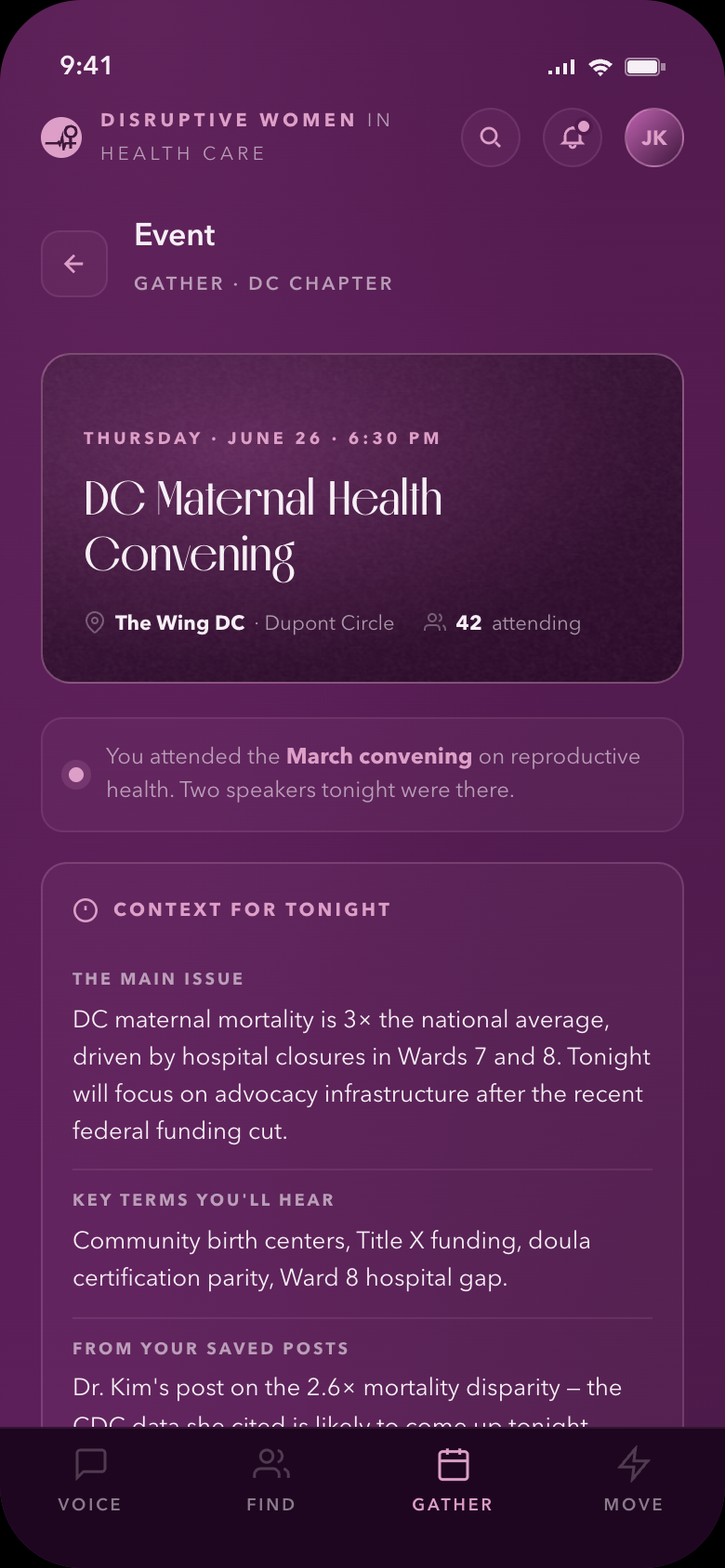
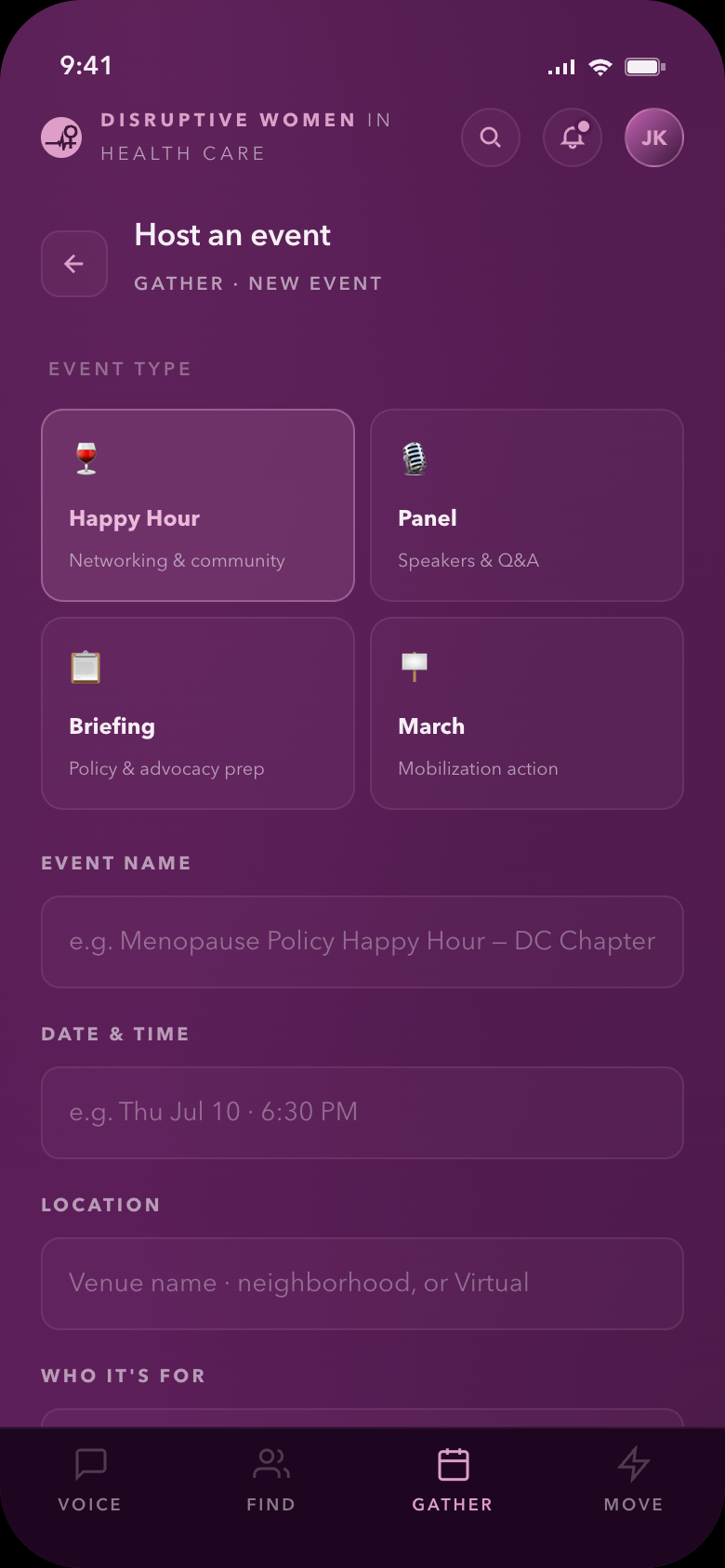
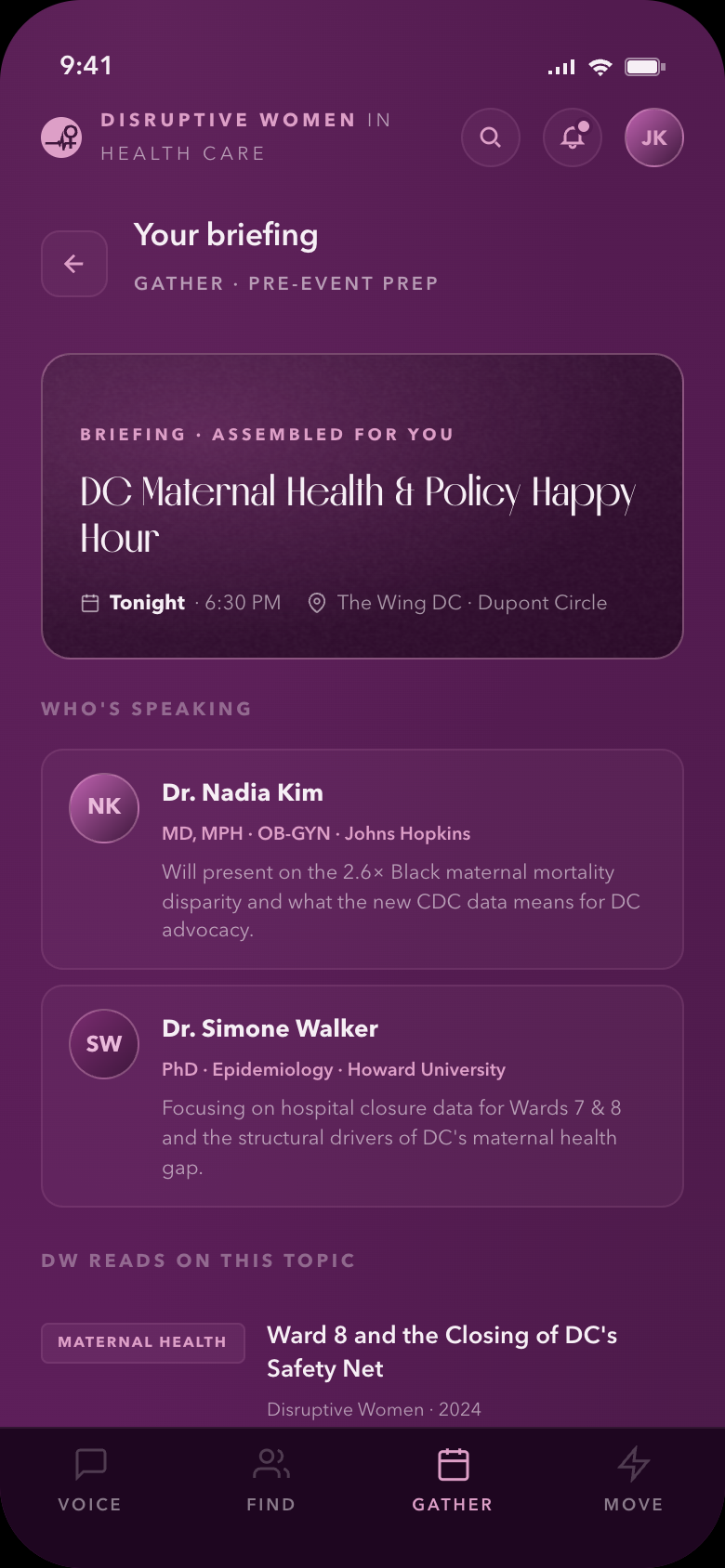
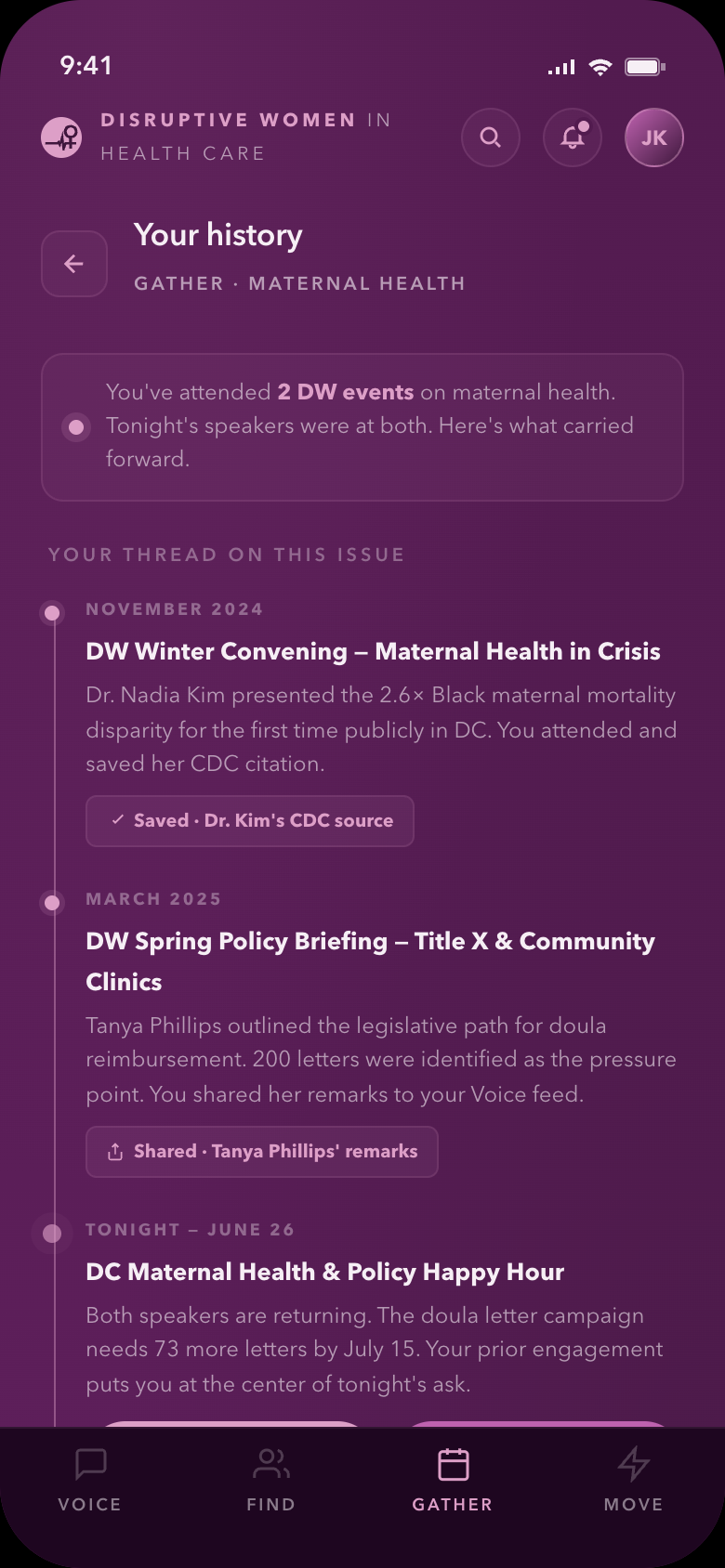
Host mode maps the attending members as a network — who’s coming, their focus areas, their recent posts on the topic. After the session, AI structures the key policy positions into a briefing note. A continuity card resurfaces prior engagement the next time this topic comes around.

  • Host view — attending members as a network map, not a headcount
  • Post-event briefing — AI structures key positions; searchable, shareable, indexed to the event
  • Continuity — you attended the April briefing on this bill; the vote is Thursday
03 · Find

Your network, made legible.

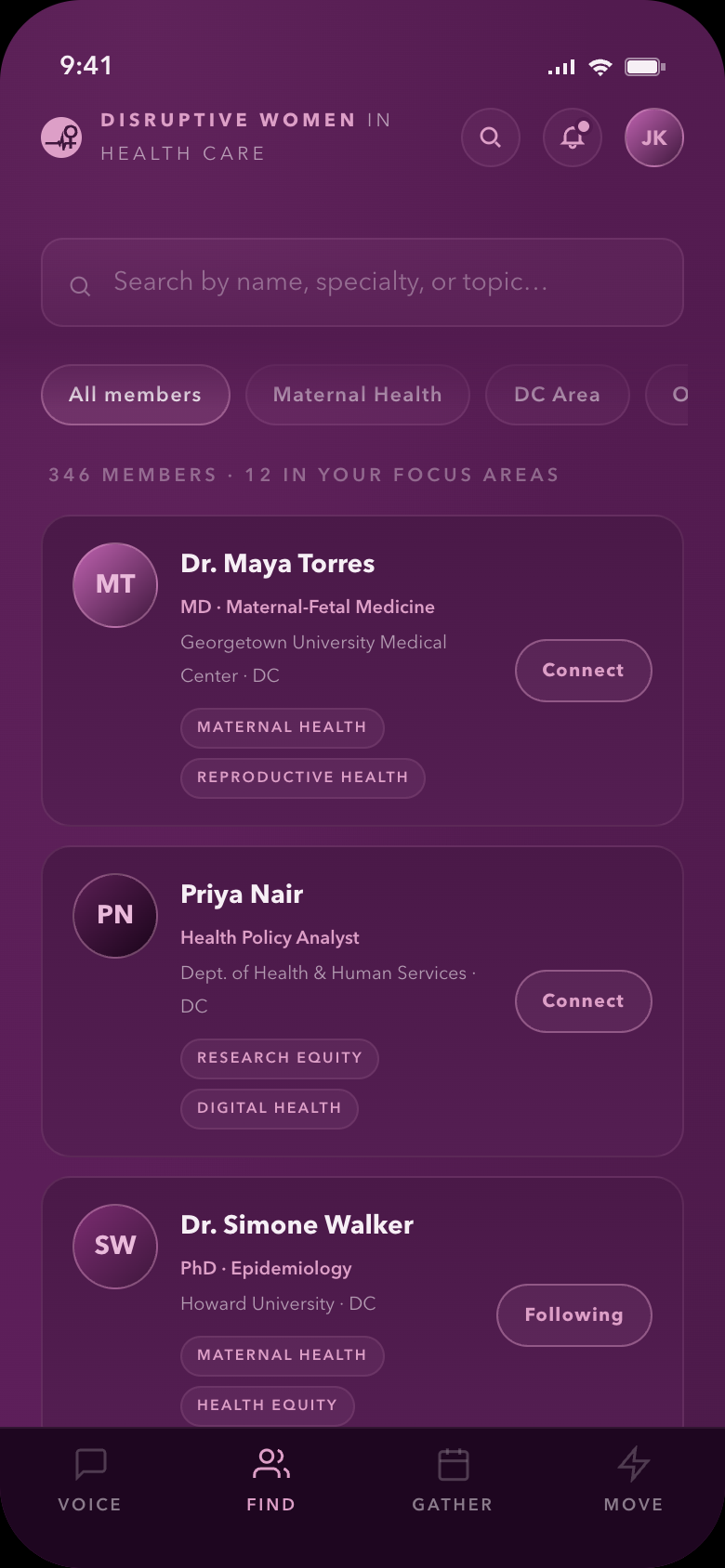
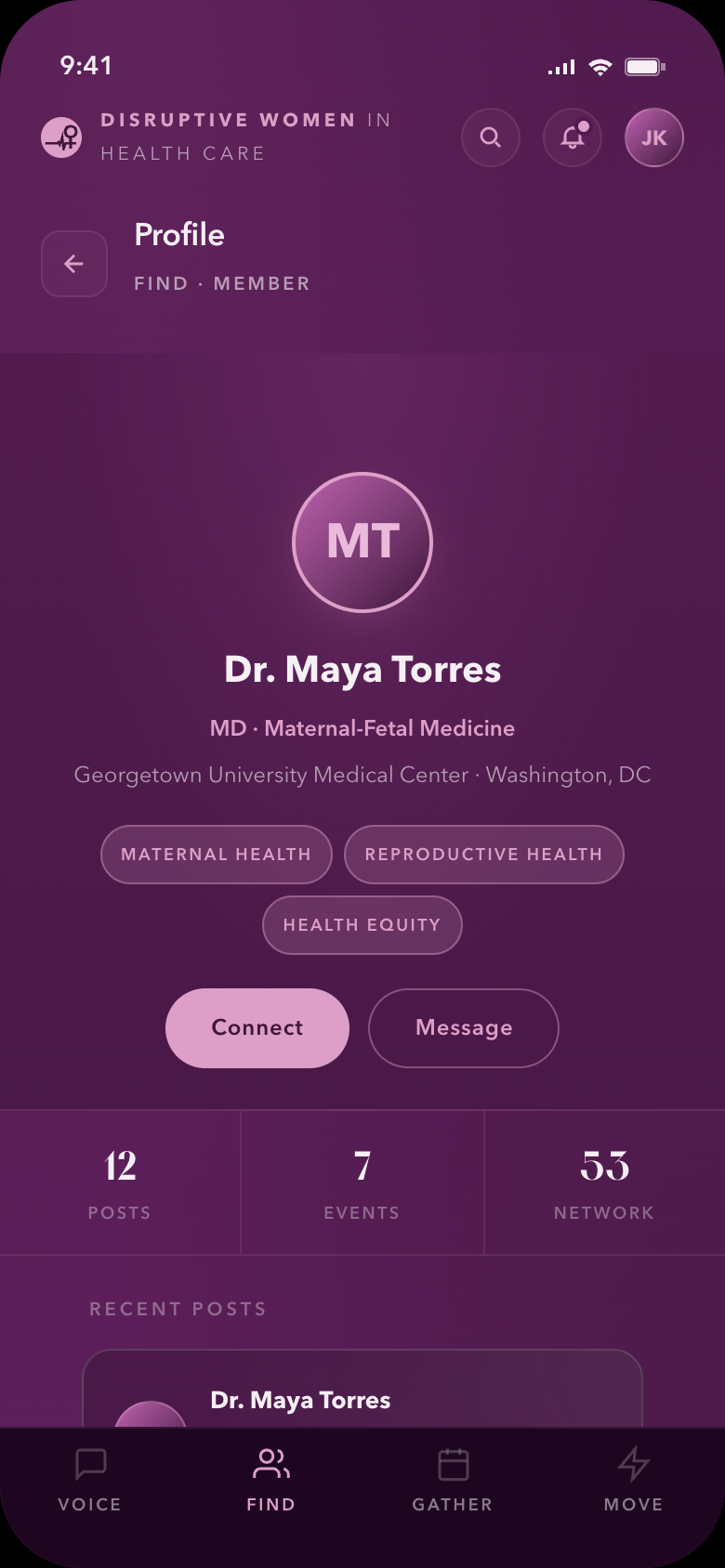
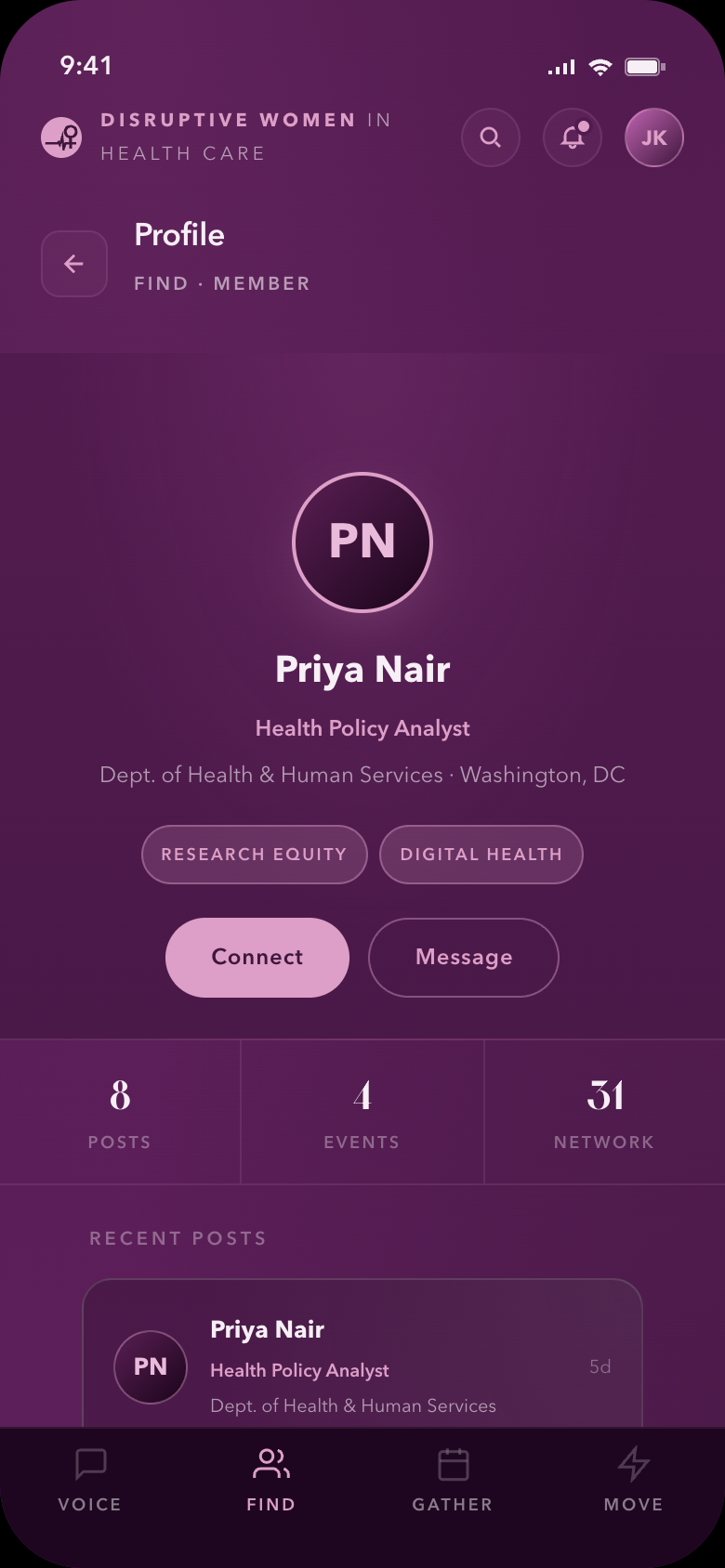
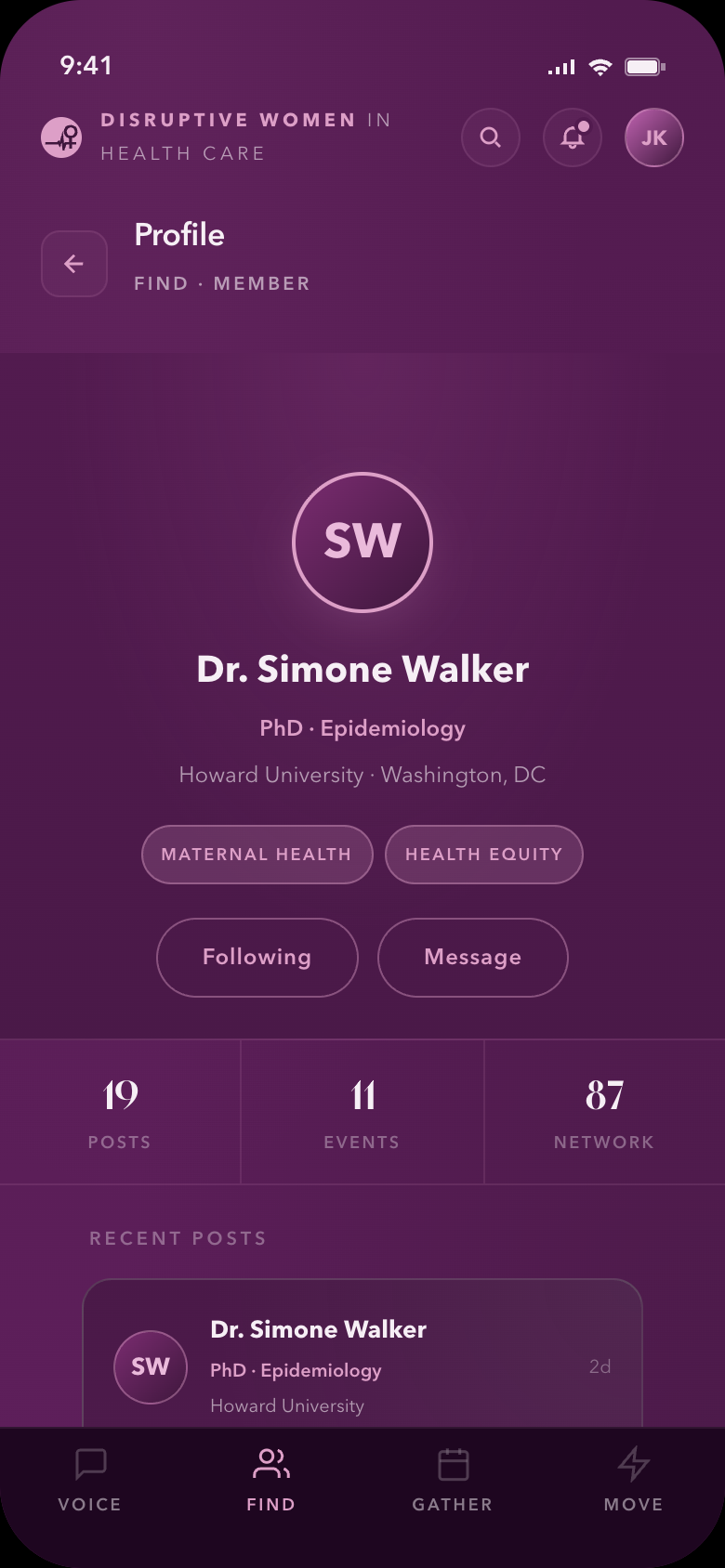
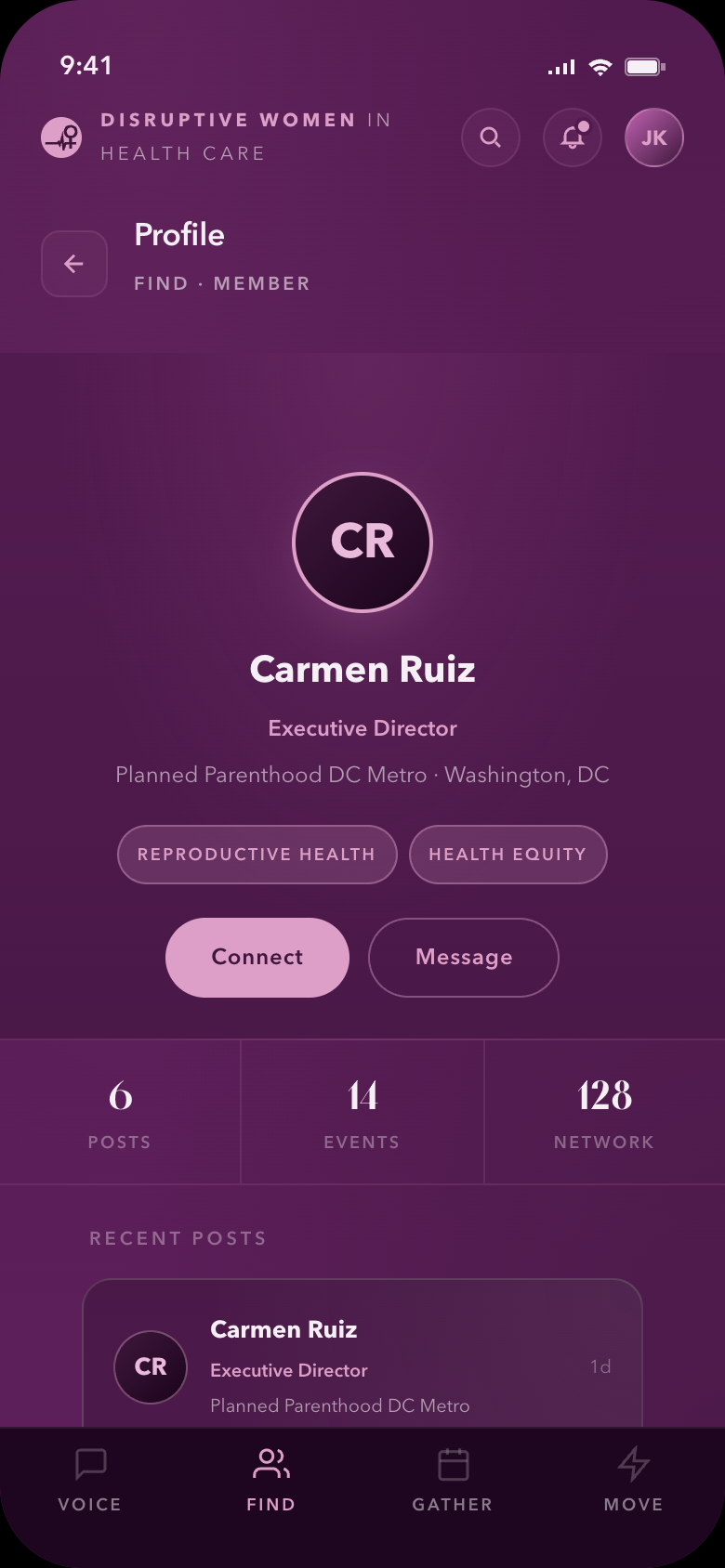
Find makes the membership searchable by focus area, location, credential, and affiliation — not just name. Each profile is a working record: published positions, legislative engagement, event appearances. Four profiles show how the depth scales across different member specialties.

  • Multi-facet search — focus area · credential · location · name, composable and live
  • Member depth — posts, campaigns, event appearances in one profile
  • Network breadth — maternal health OB-GYN to oncology researcher to epidemiology PhD to nonprofit executive director, same profile structure
04 · Listen

Insight structured, not lost.

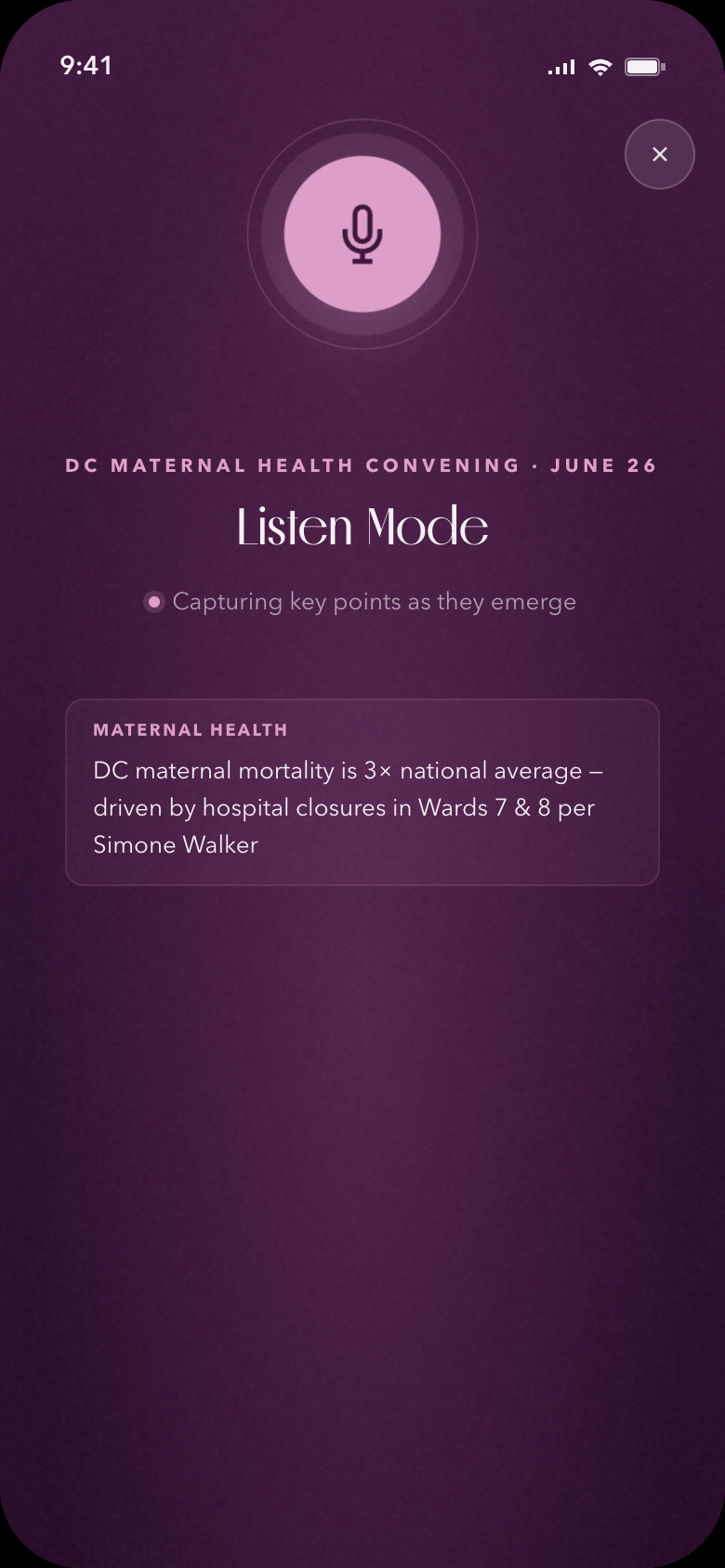
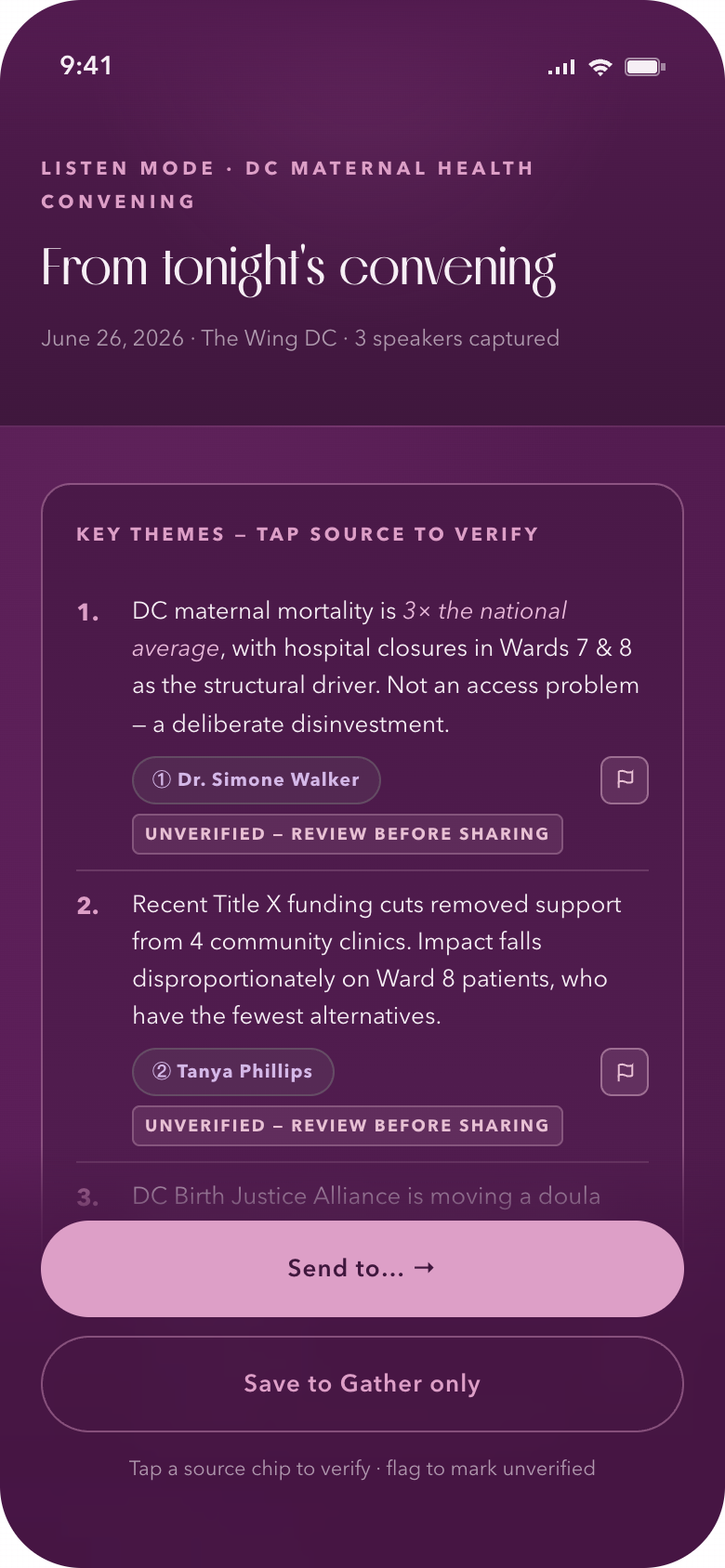
Listen puts members inside live audio sessions and congressional testimony feeds. AI captures themes and key claims in real time and delivers a structured briefing note the moment the session ends — minimizable, so the member stays present in the room.

  • Ambient capture — minimize to a persistent pill; return to the summary when the session ends
  • Claim verification — tap any point to expand the named source passage; flag it unverified before it leaves your hands
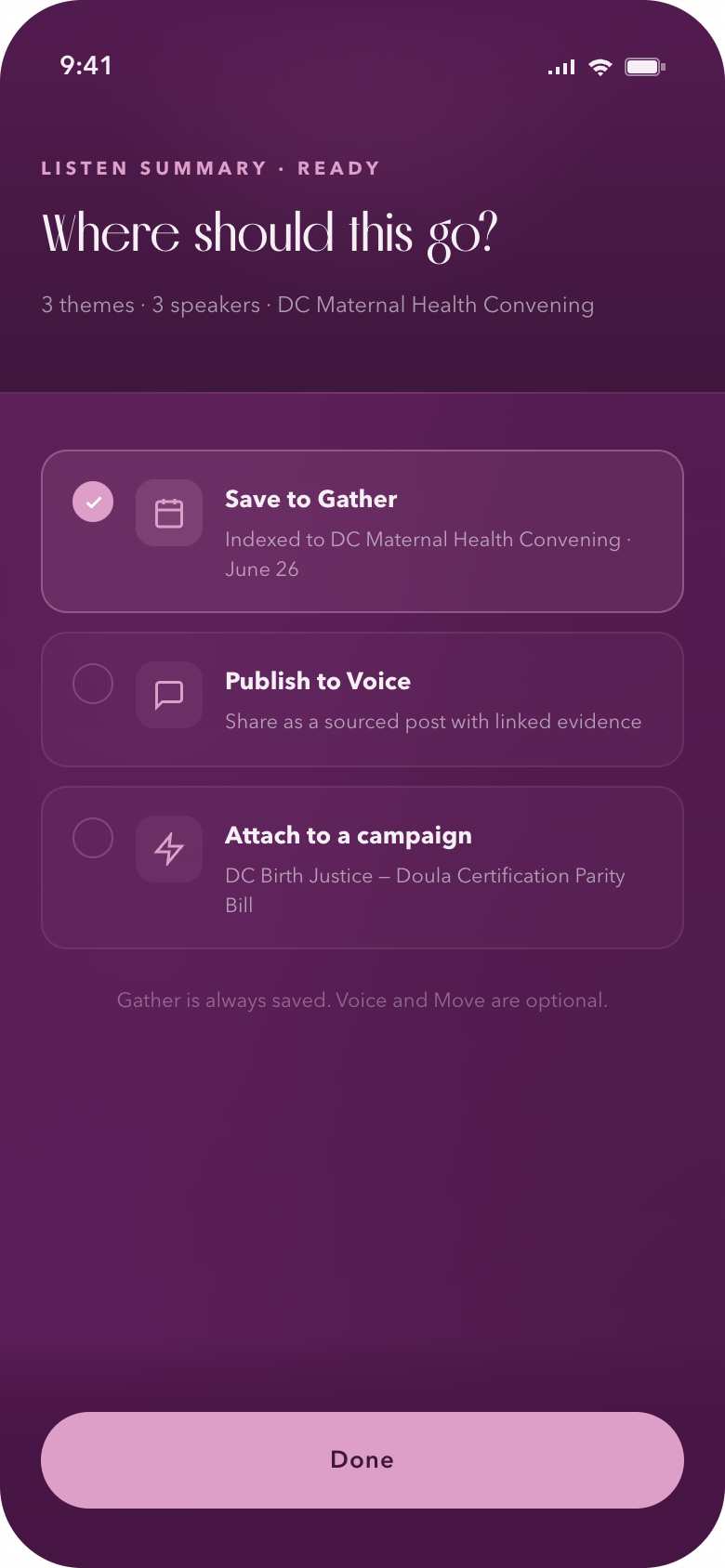
  • Output routing — send the summary to Gather, Voice, Move, or all three in one step
05 · Move

From conviction to action.

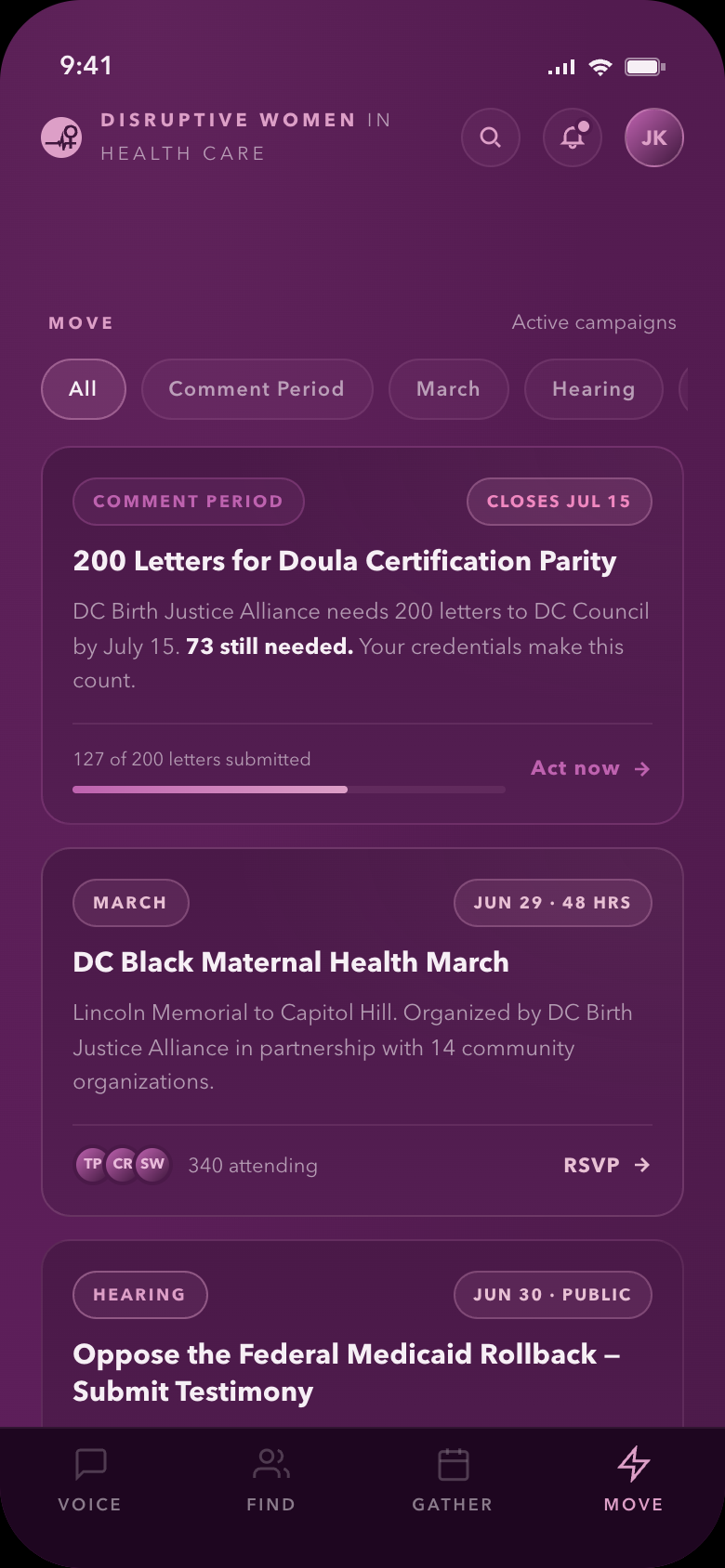
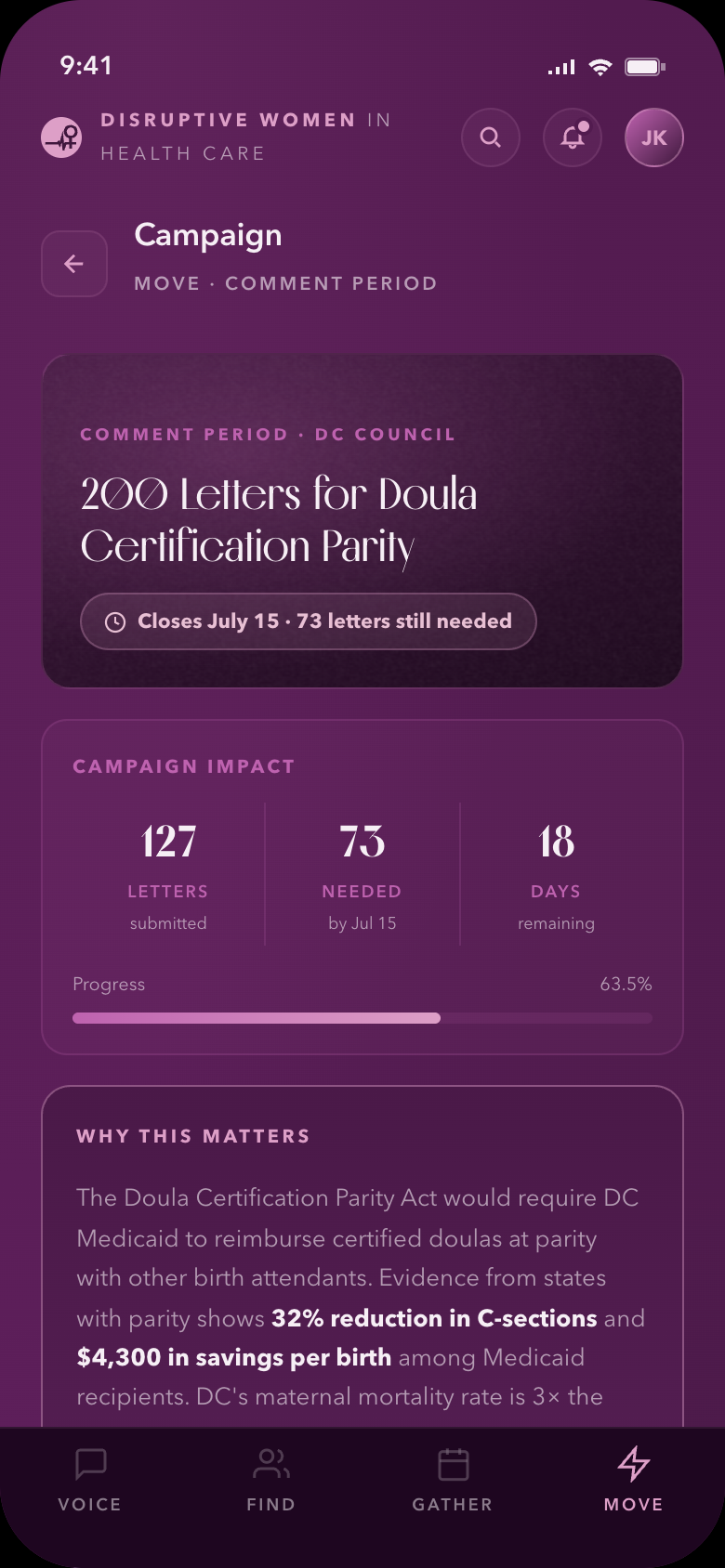
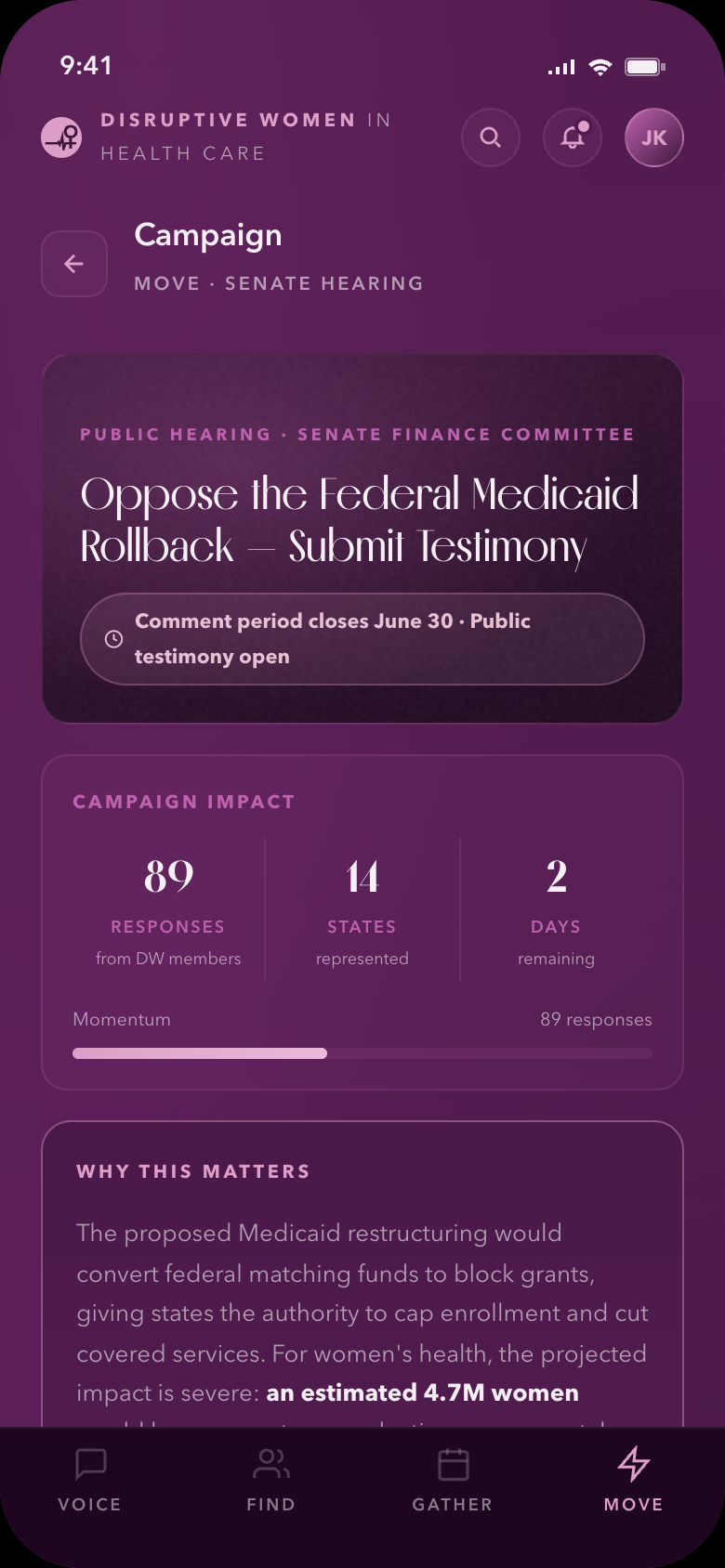
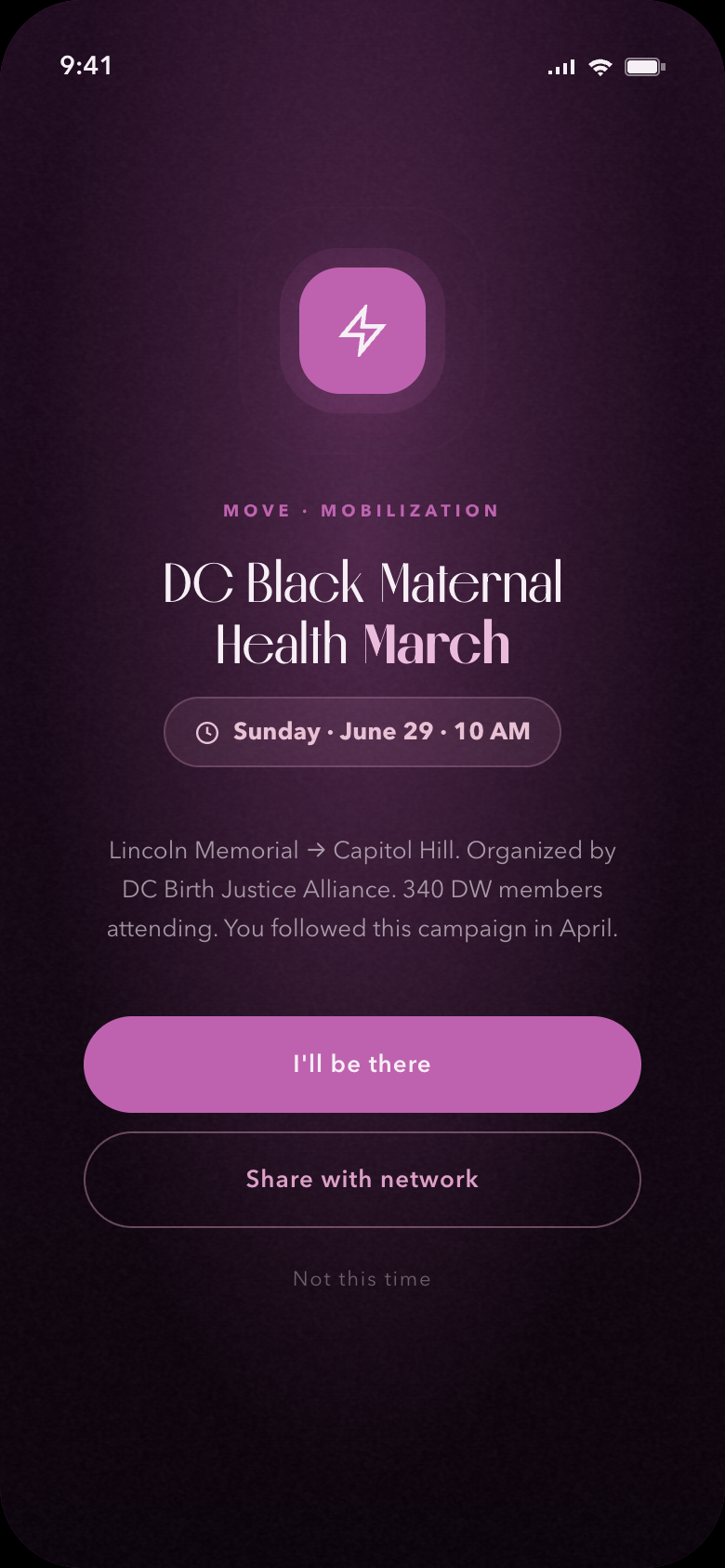
Move tracks legislation filtered to each member’s focus areas. Every bill has a plain-language summary, an AI-sourced evidence brief with claim-level citations, and a direct participation path. Two bill cards show the same structure across a comment period and a Senate testimony — then a push notification closes the loop when the bill advances.

  • Bill tracking — filtered to member focus areas, updated in real time
  • Evidence brief — AI-sourced claims and cited studies; one tap to expand the passage
  • Two participation paths — Doula Certification Parity (comment period) and Medicaid Rollback (Senate testimony)
  • Bill advance alert — she knows first; one-tap action from the notification
06 · Impact

Progress, owned.

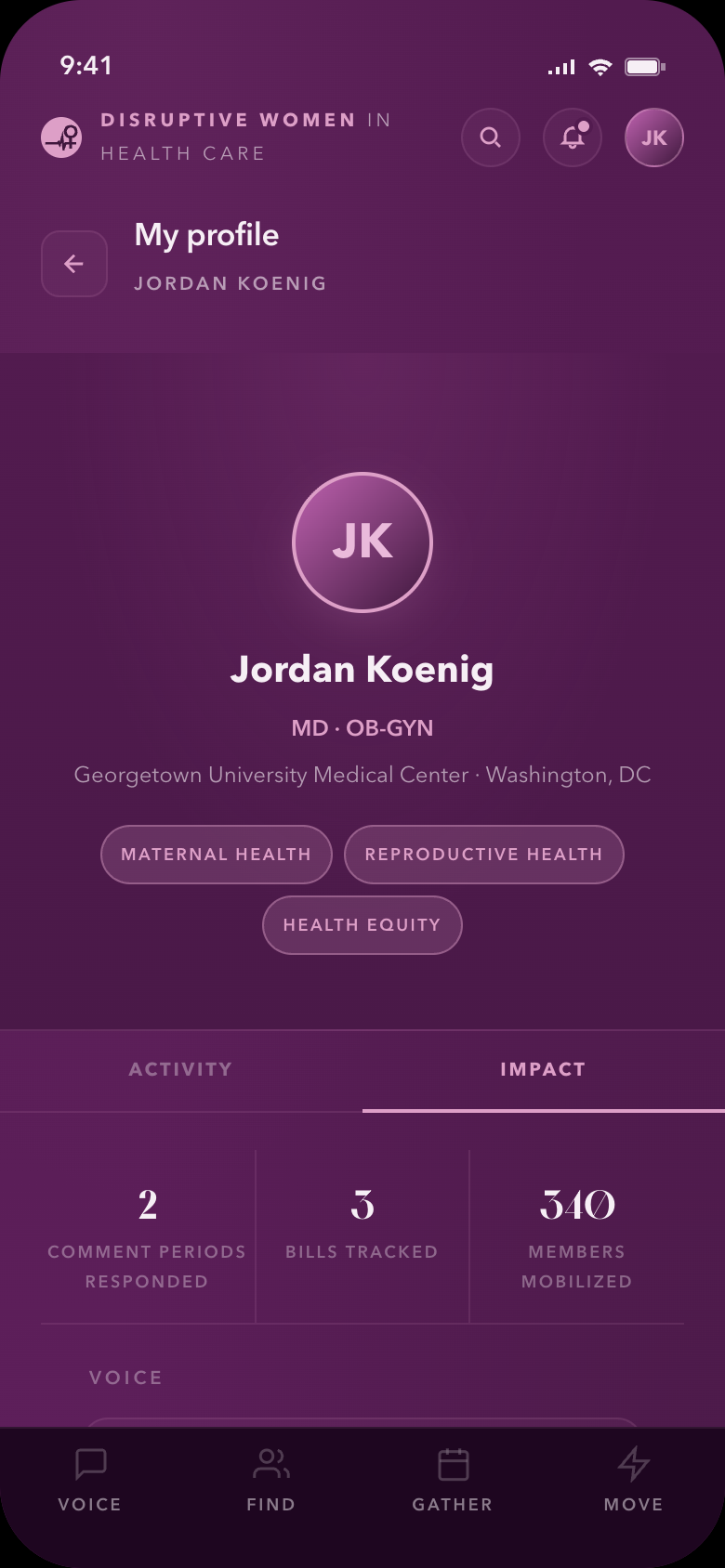
The Impact dashboard shows each member what she has actually moved — comment periods responded to, bills tracked, members mobilized. Her sourcing record and specific written action in each campaign sit alongside the collective outcomes. Advocacy has always been measured by organizers and funders; this returns that read to the individual member.

  • Process outcomes — comment periods, bills tracked, members mobilized; not follower counts
  • Campaign record — her specific action alongside collective results (letters, marchers, testimonies)
  • Collective impact — what the coordinated network submitted together, attributed back to her contribution